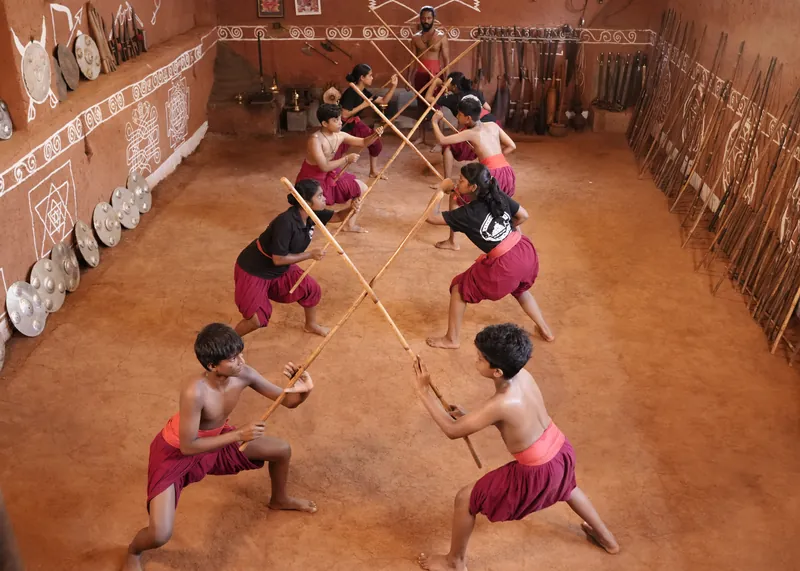
Kettukari is the long staff of Kalaripayattu. It is usually the first wooden weapon a student learns, and it opens Kolthari, the stage of wooden weapons. It teaches distance, timing and how to move a weapon with the whole body.
After the long staff comes the short stick, called cheruvadi. Later, many students go on to the curved stick, the otta. Together, these sticks form the bridge between body training and metal weapons.
This guide explains what the kettukari is, what Kolthari covers, how the short stick follows, and how stick training is practised safely.
What is the kettukari
The kettukari is a straight, round staff. It is held in both hands and used to strike, block and turn an attack aside. It is traditionally made of cane or bamboo, though the material can vary between kalaris.
There is no single standard length. Many accounts put it at about 5 feet. Some kalaris measure it to the student's body, for example from the ground to about the forehead. What makes it a Kalari staff is less its size and more the low postures and steps used to move it.
When people search for the "kalaripayattu stick" or the "kalari long stick", this is usually the weapon they mean.
Kolthari: the stage of wooden weapons
Kalaripayattu is taught in 4 stages: Meithari (body training), Kolthari (wooden weapons), Angathari (metal weapons) and Verumkai (bare hands). Our guide to the 4 stages of Kalari explains each one.
The name Kolthari comes from kol, the Malayalam word for a stick. In this stage, the student learns to carry everything from body training into a weapon. The usual order is from long to short, then curved:
| Wooden weapon | Malayalam name | What it mainly teaches |
|---|---|---|
| Long staff | Kettukari | Distance, timing and power from the whole body |
| Short stick | Cheruvadi | Speed, close-range blocks and quick footwork |
| Curved stick | Otta | Precise strikes, very low postures and marma knowledge |
The exact order and the names can differ between styles and families. The otta is often seen as the most advanced of the wooden weapons. You can read more in our guide to the otta, the curved stick.
What the long staff teaches
Distance
The long staff lets a student strike from far away. It also lets a partner strike from far away. So the first lesson is the gap between 2 people. The student learns where the tip reaches, and where it does not. This sense of distance is used in every weapon that follows.
Timing
In partner work, a block that comes too early leaves the body open. A block that comes too late does not work at all. The staff teaches the student to move at the right moment, in rhythm with the partner. Many sequences have a steady beat that both partners must keep.
Whole-body power
A staff swung with the arms alone is slow and weak. In Kalari, the strike starts in the feet, passes through the hips and ends in the hands. The steps learned in Meithari, called chuvadu, the Kalari footwork, now carry a weapon with them. A student who cannot hold a low posture steadily cannot yet move a staff well.
A base for later weapons
Many grips and turns of the long staff carry over to the spear. This is why long staff training is often called the preparation for spear work.
Cheruvadi: the short stick that follows
Once the long staff is steady, the student moves to the cheruvadi, the short stick. Many accounts describe it as about 3 palm spans long, which is roughly 2½ feet. Some kalaris use other names for it, such as muchan.
The short stick changes the work:
- Partners stand much closer.
- Strikes and blocks come faster, one after another.
- The footwork becomes quicker and tighter.
- The student needs sharper attention, because there is less time to react.
At Athma Kalari, the 2-month Kalari Parisrema program ends with an introduction to Cheruvadi. It is a first taste of stick work, built on 2 months of kicks, footwork and body sequences. Full Kolthari training takes much longer.
How stick training is practised safely
Wooden weapons are more forgiving than metal ones, but a staff can still bruise, sprain or break a finger. Safe stick training follows a clear order:
- Body training first. Strong legs, open hips and good balance come before any stick.
- Solo sequences. The student learns each sequence alone, slowly, until it is clean.
- Slow partner work. Pairs follow a fixed sequence, so both know what comes next. One attacks, one defends, then they swap.
- Speed comes last. The teacher allows more speed only when both partners stay controlled.
A few simple habits keep stick work safe:
- Check the stick for cracks or splinters before training.
- Keep a clear space around each pair.
- Keep the eyes on the partner, not on the stick.
- Practise partner work only with a teacher present.
For a wider look at injuries and how training keeps them rare, read is Kalaripayattu dangerous.
FAQs
Q: What is kettukari in Kalaripayattu?
A: Kettukari is the long staff. It is usually the first wooden weapon a student learns, at the start of Kolthari.
Q: What is Kolthari?
A: Kolthari is the second stage of Kalaripayattu, the stage of wooden weapons. It usually covers the long staff, the short stick and the curved otta.
Q: How long is the kalari long stick?
A: There is no single standard. Many accounts put it at about 5 feet, and some kalaris measure it to the student's height.
Q: What is cheruvadi?
A: Cheruvadi is the short stick, often described as about 3 palm spans long. It is learned after the long staff and is faster, closer work.
Q: Can I start Kalaripayattu with stick training?
A: No. Stick work comes after body training. Without strong legs and steady postures, a stick cannot be moved well or safely.
Start with the body, then the stick
The long staff comes after the basics, so the first step is body training. Our residential programs run from 10 days to 2 months. Kalari Sadhana (10 days) introduces the long stick, and the 2-month program includes an introduction to Cheruvadi. Ashan Vipin Das recommends 2 months as the shortest stay. You can compare them on our residential Kalari programs page.