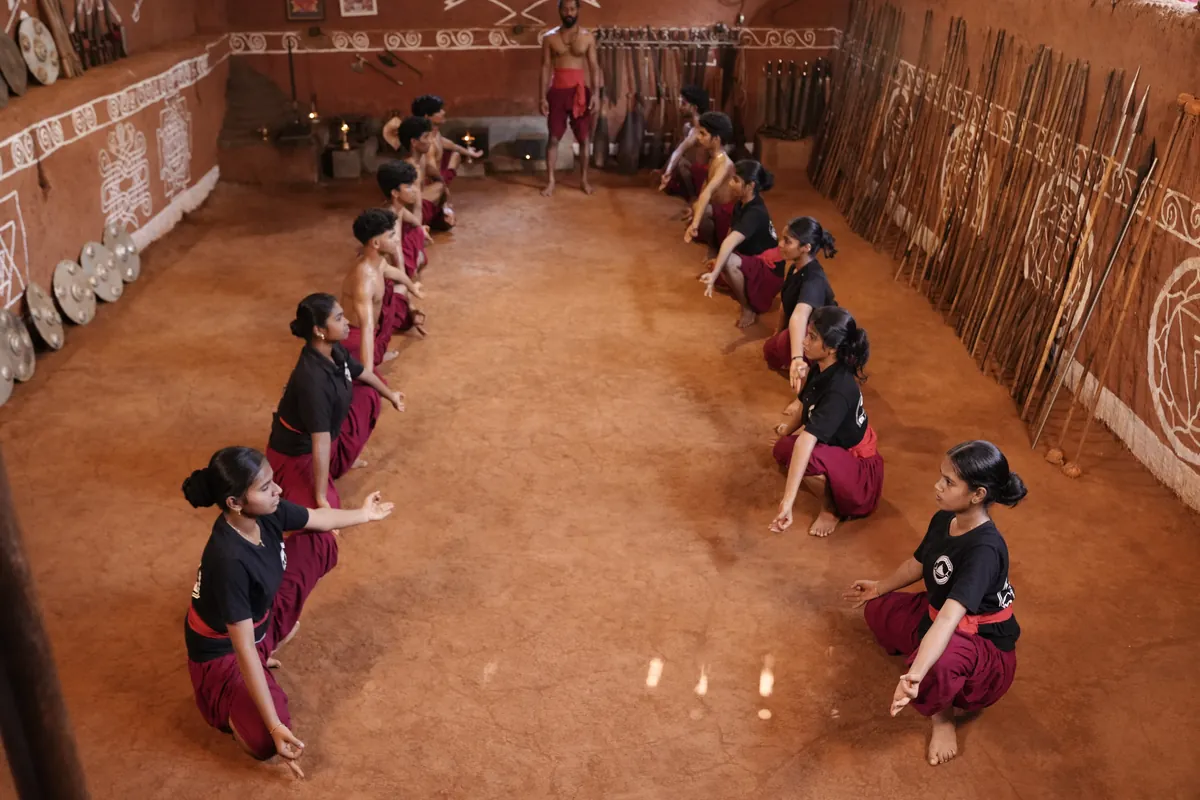
There are no coloured belts in traditional Kalaripayattu. Students do not test for a white, yellow or black belt. Progress follows 4 stages of training, and the teacher decides when each student is ready to move on.
The only "belt" in Kalari is the training cloth wrapped around the waist, the uduthuketti or kacha. Every student wears the same one, from the first day to the last. You can read about it in our guide to the Kalaripayattu dress and kacha.
This page explains how Kalaripayattu levels really work, what titles like Gurukkal and Ashan mean, and what a certificate shows.
Why there are no coloured belts
Coloured belts came from Japanese martial arts, and they spread around the world in the 20th century. Kalaripayattu is much older than this system, and it grew in a different way.
Kalari was passed from teacher to student, often inside a family or a small kalari. The teacher saw every student every day. There was no need for an outside sign of rank, because the teacher already knew exactly what each student could do. Your level showed in your body: in how low and steady your stance was, and in how you moved.
Some schools today use written levels or grading to suit modern students. The traditional way, which Athma Kalari follows, is the teacher's judgement.
The 4 stages of Kalaripayattu
In place of belts, Kalaripayattu has 4 stages. Each stage is built on the one before.
| Stage | What you learn | Main focus |
|---|---|---|
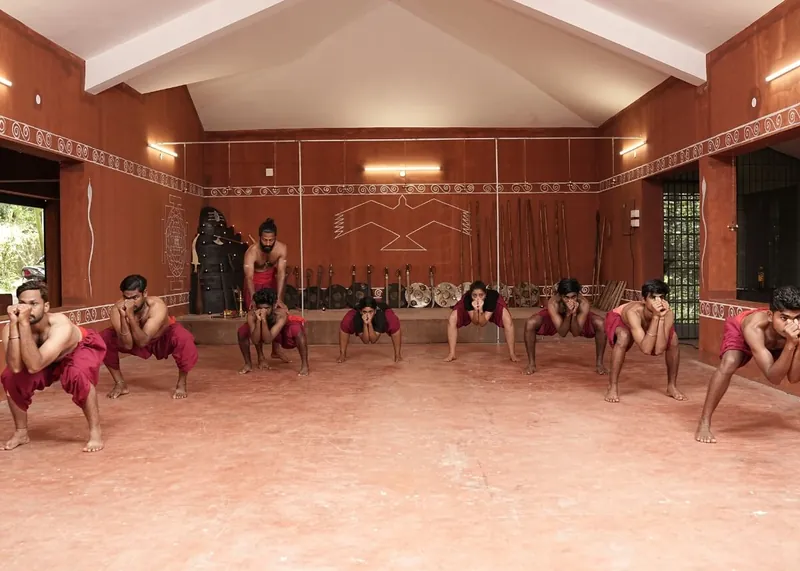
| Meithari | Body training: kicks (kaalukal), footwork (chuvadu), animal postures (vadivu) and body sequences (meypayattu) | Strength, flexibility, balance and control |
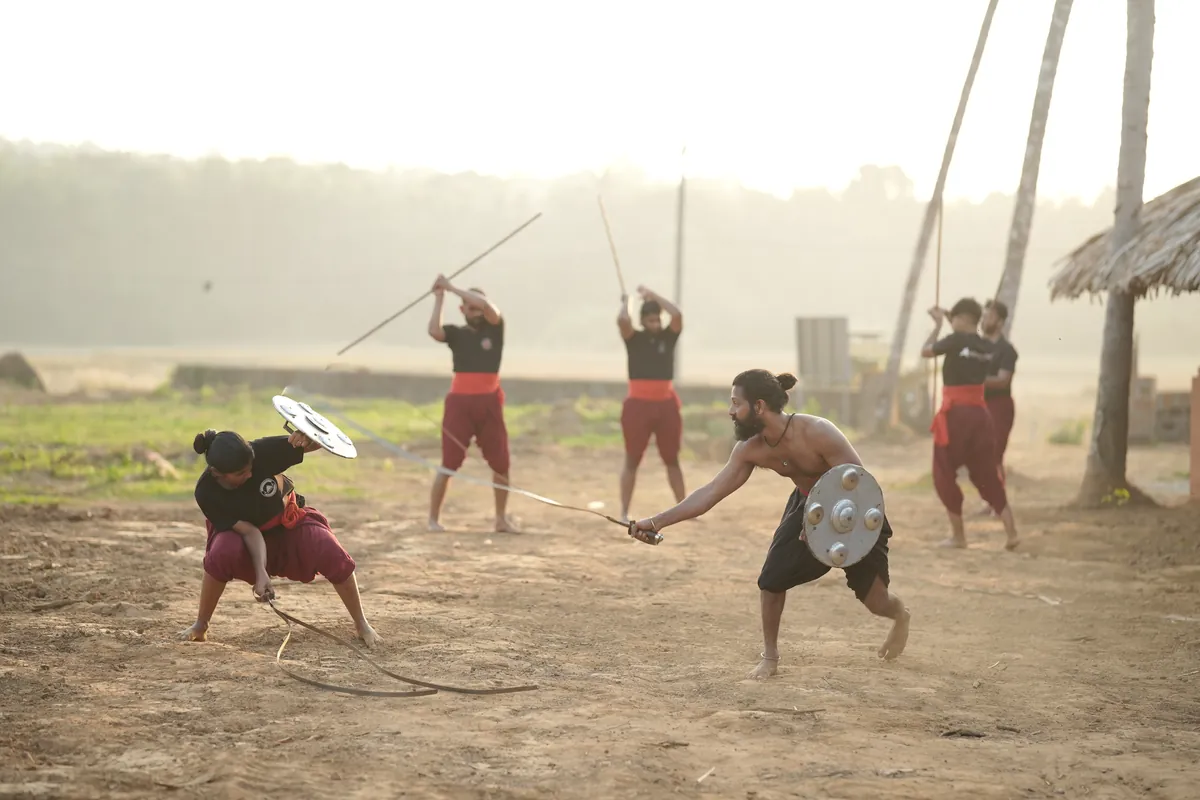
| Kolthari | Wooden weapons, such as the long staff and the short stick (cheruvadi) | Distance, timing and coordination |
| Angathari | Metal weapons, such as the dagger, the sword and shield, and the spear | Precision and control with sharp weapons |
| Verumkai | Bare-hand fighting: strikes, blocks and locks | Using everything learned, without a weapon |
These stages are not short levels you pass in a few months. Each one takes years. Ashan Vipin Das advises students that learning Kalari fully takes decades. Our guide to the stages of Kalari explains each one in detail.
Who decides when you move up
The teacher does. There is no fixed test date. The teacher watches you every day and decides when you are ready for the next exercise, the next sequence or the next stage.
A teacher usually looks for:
- A steady, correct stance that holds when you are tired.
- Control: moving with care, not just with force.
- Regular practice and attention in class.
- Respect for the kalari, the teacher and other students.
At Athma Kalari, you also need at least 90% attendance to move up a level and to receive a certificate. Turning up is part of the training.
Levels within the residential programs
For residential students, the programs give a clear structure inside Meithari:
- Kalari Praramba, 2 weeks: warm-up, Vandanam, 6 kicks, the first footwork, body sequence and Vadivu.
- Kalari Parijaya, 1 month: 8 kicks, 2 footwork patterns, 2 body sequences and more.
- Kalari Parisrema, 2 months: 10 kicks, 3 footwork patterns, 3 body sequences and an introduction to Cheruvadi, the short stick.
Each program builds on the one before, and you can stay for up to 1 year.
Titles: Gurukkal, Ashan and others
Kalari does not have ranks in the modern sense, but it does have titles of respect.
- Gurukkal is a title often used for the master who heads a kalari, especially in northern Kerala. It is earned through many years of practice and teaching.
- Ashan means teacher. Students use it as a respectful way to address the person who teaches them. At Athma Kalari, students call the teacher Ashan Vipin Das.
How these titles are used differs between regions and families. A teacher's standing comes from lineage and years of practice, not from a certificate. Ashan Vipin Das has 29 years of Kalari practice and is the 8th generation of a Valluvanad Kalari family. You can read about his lineage on our about us page.
What a Kalari certificate means
At the end of each residential program at Athma Kalari, you receive a completion certificate. It shows that you completed that program and its training with at least 90% attendance.
A program certificate is not a rank and not a licence to teach. Teaching needs its own training. At Athma Kalari, you first complete Kalari Parijaya, then the 4-month Kalari TTC, which covers teaching technique. To be certified, you complete the full months. See our guide to Kalaripayattu teacher training and certification.
A certificate records your training. Your real level is in your body, and that is what the teacher sees.
FAQs
Q: Does Kalaripayattu have a black belt?
A: No. Traditional Kalari has no coloured belts. Progress follows the 4 stages, and the teacher decides when you move on.
Q: What are the levels in Kalaripayattu?
A: The 4 stages are Meithari (body training), Kolthari (wooden weapons), Angathari (metal weapons) and Verumkai (bare-hand fighting).
Q: Is there a grading test in Kalari?
A: Not in the traditional way. The teacher watches you every day. At Athma Kalari, you also need at least 90% attendance to move up a level.
Q: What is the difference between Gurukkal and Ashan?
A: Both are titles of respect. Ashan means teacher. Gurukkal is often used for a master who heads a kalari. Usage differs between regions and families.
Q: How long does each stage take?
A: It is different for every student. Each stage takes years, and learning Kalari fully takes decades.
Q: Can I teach Kalari with a program certificate?
A: No. A program certificate shows you completed that training. To teach, you complete the Kalari TTC.
Start at the first stage
Every Kalari student, at every school, begins with Meithari. Our residential Kalari programs start you there, from 2 weeks to 2 months, with Ashan Vipin Das watching your progress every day.