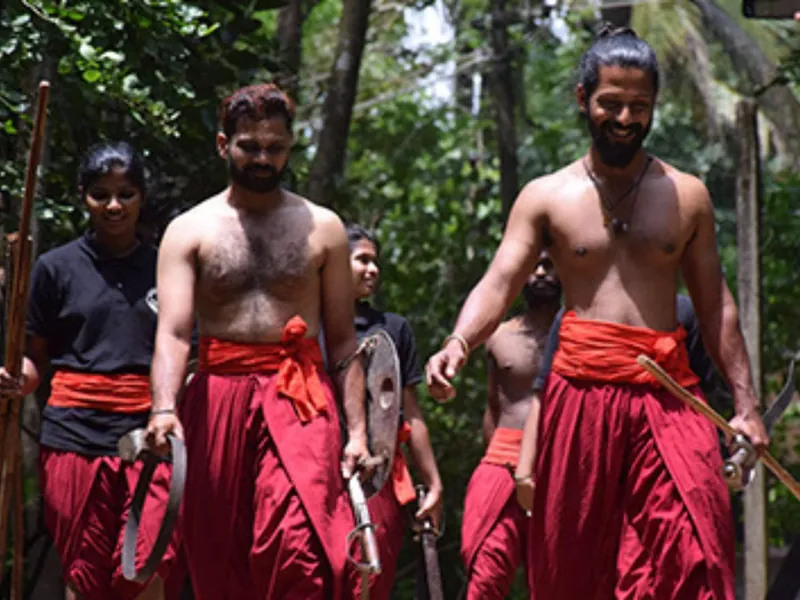
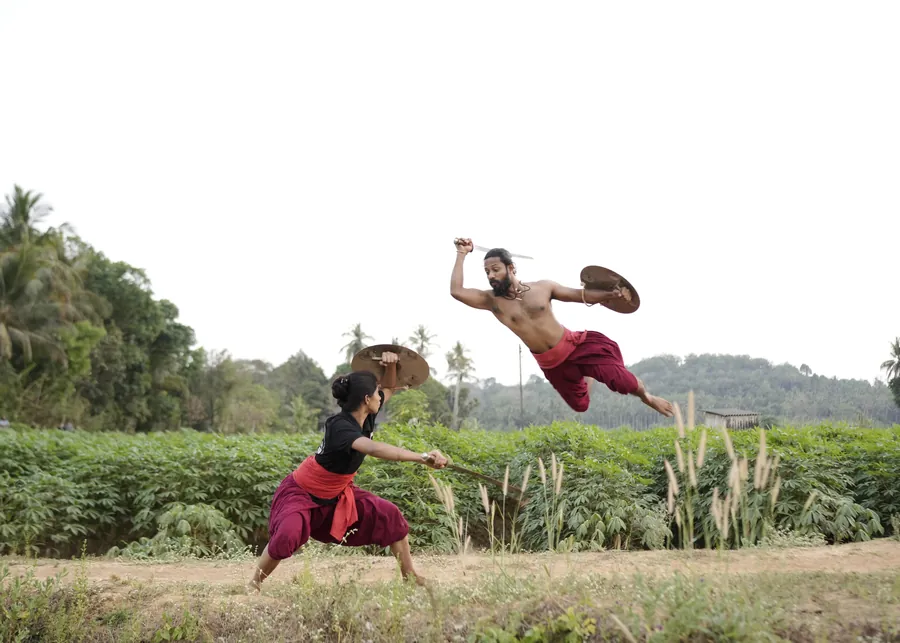
The Kalaripayattu sword is called the val. It is used with a small round shield called the paricha. Together, sword and shield practice is often called valum parichayum, which simply means sword and shield.
This work belongs to Angathari, the stage of metal weapons. It is one of the most striking parts of Kalaripayattu to watch. It is also one of the last things a student learns, after years of body training and stick work.
This guide explains the sword and shield, how they are taught, and why the path to them is long.
The val: the Kalari sword
The val is a metal sword held in one hand. Its shape is not the same in every kalari. Blades can be straight or slightly curved, longer or shorter, depending on the family tradition and the region.
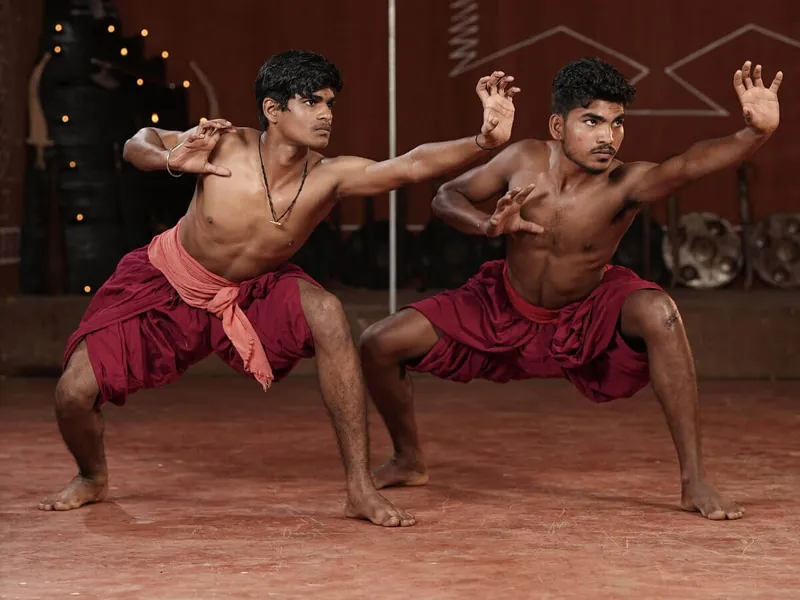
In Kalari, the sword is not swung with the arm alone. Each cut and block comes from the legs, hips and steps. This is why the Kalari sword looks so fluid in a good demonstration. The body learned to move long before the sword was in the hand.
The paricha: the Kalari shield
The paricha is a small, round shield held in the other hand. It is light enough to move fast. The student uses it to block, to turn an attack aside, and to protect the body while the sword works.
Materials vary between traditions. What matters more is how it is used. The shield and the sword move as a pair, and the student must learn to use both hands at once without losing the footwork.
Kalari weapons by name
People often search for the names of Kalari weapons. Here are the main ones, in the order they are usually learned. The exact list differs between styles and families.
| Stage | Weapon | Malayalam name |
|---|---|---|
| Kolthari (wood) | Long staff | Kettukari |
| Kolthari (wood) | Short stick | Cheruvadi |
| Kolthari (wood) | Curved stick | Otta |
| Angathari (metal) | Dagger | Kattaram |
| Angathari (metal) | Sword | Val |
| Angathari (metal) | Shield | Paricha |
| Angathari (metal) | Spear | Kuntham |
| Angathari (metal) | Flexible sword | Urumi |
For more on each one, see our guide to weapons in Kalaripayattu.
How sword and shield are taught
Every kalari has its own sequences, but the general method is much the same.
Alone first
The student first learns sword and shield movements alone. These are set sequences of steps, turns, low postures, cuts and blocks. They are repeated many times until the body knows them without thinking.
Then in pairs
Next, 2 students practise together. Each pair sequence is fixed: one attacks and the other defends, then they swap. Because both know the order, they can focus on distance, timing and control. In many kalaris, students first practise with blunt or wooden swords. Real blades come only at a much later level.
Speed comes last
Pairs start slowly, step by step. As they become safe and steady, the teacher lets them go faster. In a good demonstration, the speed looks dangerous. It is safe only because of years of slow, careful work behind it.
Why it comes only after years of training
Students often ask when they can learn the sword. The honest answer is: not soon. Kalaripayattu is taught in 4 stages, and the sword sits in the third. Our guide to the 4 stages of Kalari explains the full order.
There are good reasons for this order:
- The legs come first. Sword work needs the strong, low postures and quick steps built in body training.
- Sticks teach distance. Long staff, short stick and otta training teach timing and distance with a weapon that forgives small mistakes. Read about the otta, the curved stick.
- Metal does not forgive. A small error with a stick can bruise. A small error with a blade can do serious harm.
- Trust takes time. The teacher must know that a student is calm, controlled and careful before giving them a sword.
The time this takes depends on the student and the teacher. There is no fixed number of months. Our article on Kalaripayattu ranks and levels explains how progress works.
The urumi: a separate weapon
The urumi is often mentioned with the Kalari sword, but it is a different weapon. It is a long, flexible blade that can be coiled. It is not used with the paricha in the same way, and it is taught only to very advanced students, under close watch. You can read more about it in the weapons guide linked above.
Is sword training safe?
Done in the traditional order, under a qualified teacher, sword and shield work is practised with great care. The risk comes from skipping steps or copying from videos. Never try sword sequences without a teacher. For a wider look at safety in Kalari, read is Kalaripayattu dangerous.
FAQs
Q: What is the Kalaripayattu sword called?
A: It is called the val. It is used with a small round shield called the paricha.
Q: Which stage of Kalaripayattu includes sword and shield?
A: Angathari, the third stage, where metal weapons are taught.
Q: Can beginners learn the Kalari sword?
A: No. Beginners start with body training, then wooden weapons. The sword comes after years of practice.
Q: Are real swords used in training?
A: In many kalaris, students start with blunt or wooden swords. Real blades are used only at an advanced level, under the teacher.
Q: Is the urumi the same as the Kalari sword?
A: No. The urumi is a long, flexible blade and a separate weapon, taught only to very advanced students.
Where the path to the sword begins
Every Kalari swordsman started with kicks, steps and postures. At the gurukulam, you begin with Meithari, the body training, in a traditional kuzhi kalari. See the residential Kalari programs to take your first step.