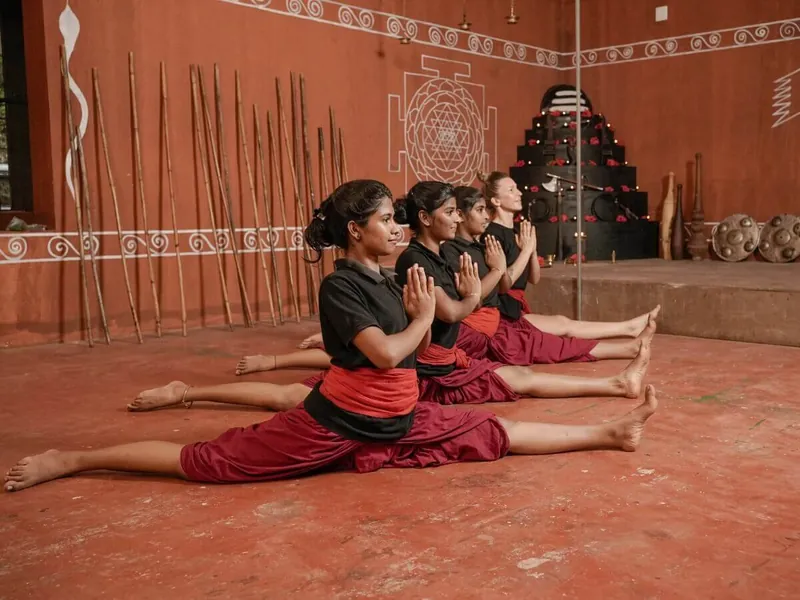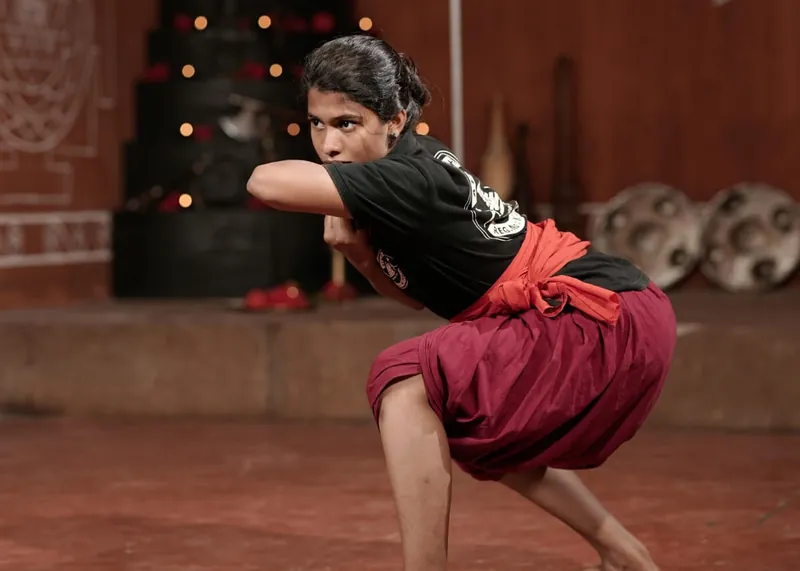
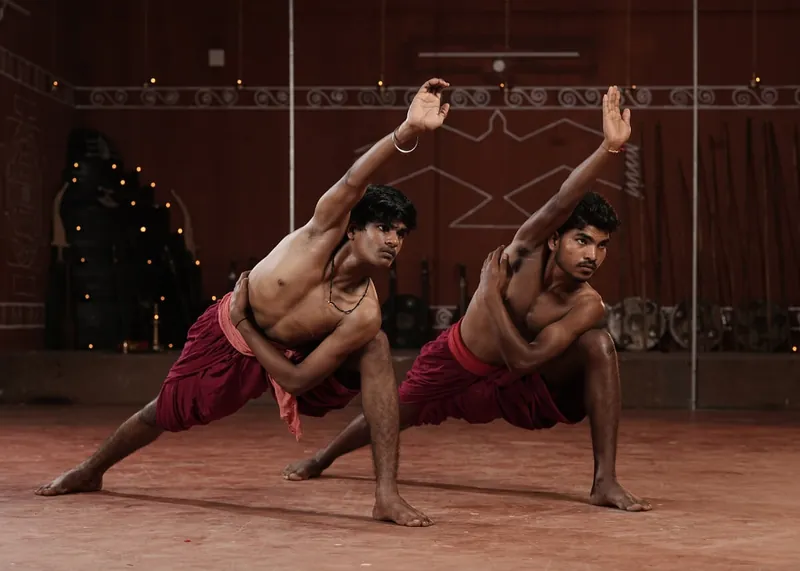
The main Kalaripayattu benefits are strong legs and core, flexible hips and spine, better balance, more stamina and steadier breathing. Kalari trains the whole body with its own weight, so most people feel a change in how they stand, move and breathe within a few weeks.
Is Kalari good for health? For most healthy people, yes, when it is learned slowly from a good teacher. It is exercise and a martial art. It is not a treatment for any condition, and it does not replace medical care.
This guide covers the physical benefits of Kalaripayattu, what usually changes after 2 weeks, 1 month and 2 months of training twice a day, and who gains the most.
The physical benefits of Kalaripayattu
Strength in the legs and core
Kalari is practised low to the ground. The animal postures, called vadivu, hold the body in deep stances. Footwork drills move you in and out of these stances again and again. This builds strong thighs, hips and calves.
The core works all the time too. Every kick, turn and jump starts from the centre of the body. You do not need weights. Your own body weight is enough.
Flexibility of the hips, spine and hamstrings
The Kalari kicks (kaalukal) swing a straight leg high to the front, the side and across the body. Done every day, they slowly open the hamstrings and hips. Bends, twists and low turns keep the spine moving in every direction.
This is active flexibility. You stretch while your muscles work, so the range you gain is range you can use.
Balance and coordination
Kalari asks you to stand on 1 leg, turn, kick and land under control. Arms and legs move together in set patterns. Over time, the body learns to stay steady and to recover quickly when it starts to tip.
Stamina
A full class at Athma Kalari lasts 2 to 2½ hours. Sequences are repeated many times, often across the whole length of the kalari. Your heart and lungs work hard, in waves, with short rests between rounds. This builds stamina that lasts.
Posture
Many stances need a long, upright spine and an open chest. The teacher corrects the back, hips and feet again and again. People who sit at a desk all day often notice they stand straighter after some weeks of practice.
Breath control
In Kalari, breath and movement go together. You learn when to breathe in and when to breathe out in each movement. Hard work starts to feel calmer, and you last longer.
Body awareness
Kalari training begins with the body itself. This first stage is called Meithari, the body training. Slow, careful repetition teaches you where your feet, knees and spine are at every moment. Many students start to notice tension and habits they never felt before.
Confidence and focus
Learning a hard movement and then doing it well builds quiet confidence. Each class also asks for full attention. If your mind wanders, you lose your balance. For the mind side of training, read our article on the mental health benefits of Kalaripayattu.
What changes with twice-daily training
At Athma Kalari, residential students train twice a day, at 5:30 AM and 5:30 PM, with Sundays off. Every body is different, so read the notes below as a general picture, not a promise.
After 2 weeks
The first days are the hardest. Most beginners feel sore, mainly in the thighs, hips and lower back. This usually eases as the body gets used to the routine.
By 2 weeks, you know the warm-up, the Kalari Vandanam and the first kicks, and they take less effort. Sleep often improves, because the days are full and regular. You will not see big changes in shape yet. You will feel less stiff and more awake.
After 1 month
By 1 month, low stances feel steadier and you can hold them longer. Kicks go higher and land more cleanly. Your breath recovers faster between rounds. Many students can now finish a full class without stopping.
This is also when the movements start to join up. Footwork, kicks and postures begin to feel like 1 practice, not separate exercises.
After 2 months
2 months is the shortest stay Ashan Vipin Das recommends, because this is when the body really starts to change. Legs and core are clearly stronger. Hips and hamstrings are more open. Standing on 1 leg feels natural. Longer sequences such as Meypayattu flow with less thinking.
Even so, 2 months is only the start. Ashan Vipin Das says learning Kalari fully takes decades. What 2 months gives you is a strong base and a routine you can keep up at home.
Who benefits most from Kalari
- Desk workers who feel stiff in the hips, back and neck after long hours of sitting.
- Dancers, actors and performers who want more control, balance and presence.
- Runners and athletes looking for strength, mobility and balance work with no equipment.
- People who practise yoga and want something more dynamic. Our article on Kalaripayattu vs yoga explains the differences.
- Complete beginners from the age of 7 upwards. No experience is needed.
Kalari is hard work, but it is built up step by step. A good teacher adjusts the load for each student.
When to be careful
See a doctor before you start if you have a recent fracture, recent surgery, severe or sudden pain, numbness or fever, or if you are pregnant. If you have a long-term health condition, ask your doctor first too. Tell your teacher about any old injury before your first class.
Start gently. Take stances less deep and kick lower in the first weeks. If you are worried about getting hurt, read is Kalaripayattu dangerous.
FAQs
Q: What are the main benefits of Kalaripayattu?
A: Stronger legs and core, more flexible hips and spine, better balance, more stamina, better posture and steadier breathing. Many people also feel more focused and confident.
Q: Is Kalari good for health?
A: For most healthy people, yes, when it is learned slowly from a good teacher. It is exercise, not a treatment. If you have a health condition, see your doctor before you start.
Q: How soon will I feel the benefits of Kalari?
A: With training twice a day, most people feel less stiff and more energetic within 2 weeks. Clear changes in strength and flexibility usually take 1 to 2 months.
Q: Do I need to be flexible to start?
A: No. Most beginners are not flexible. Flexibility comes from Kalari practice. You do not need it before you start.
Q: Do I need to be fit to start?
A: No. You start at your own level, and the teacher builds the load slowly. Beginners train alongside returning students, and advanced students help guide them.
Feel the benefits at the gurukulam
The best way to know what Kalari does for your body is to train every day. At Athma Kalari you train twice a day in a traditional pit kalari, eat 3 vegetarian meals a day and live at the gurukulam. Our residential Kalari programs run for 2 weeks, 1 month or 2 months, and you start the day you arrive.