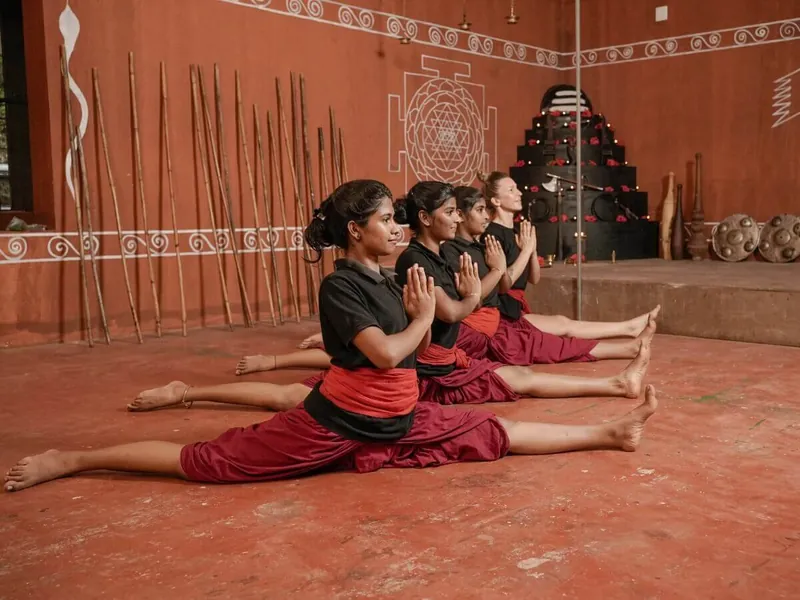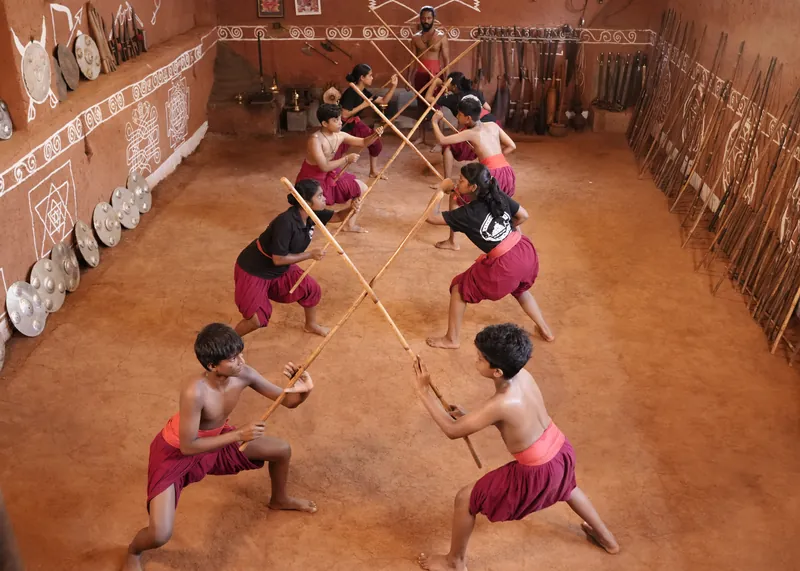
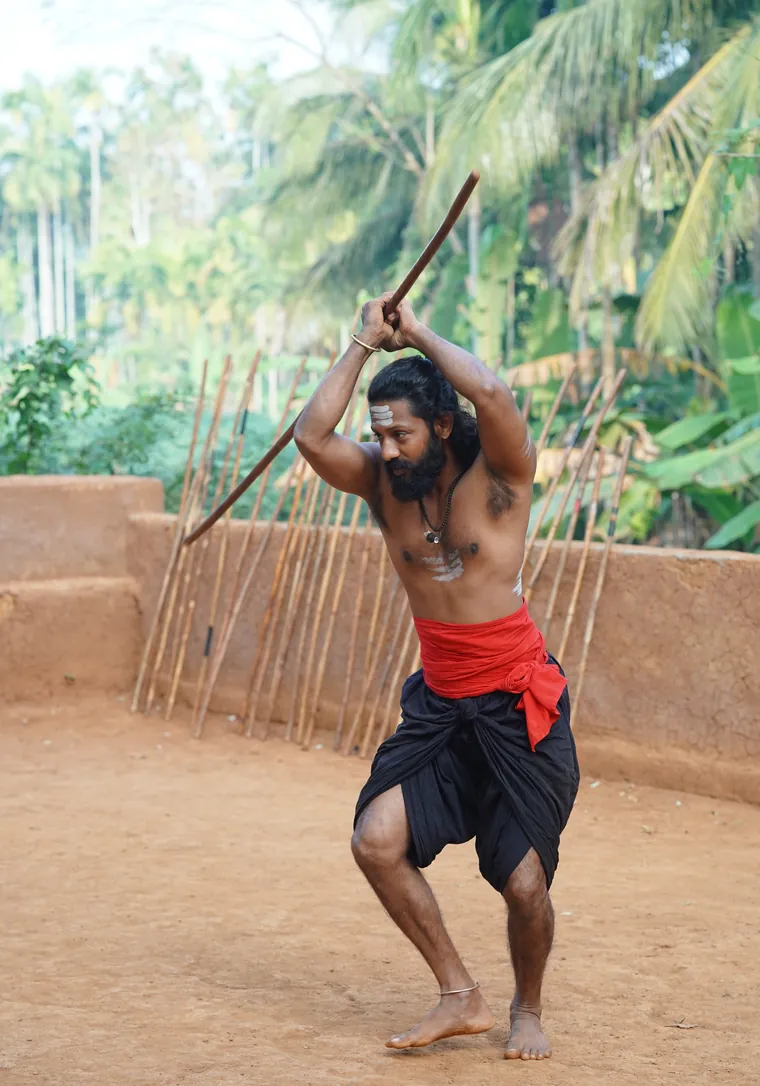
The martial art of Kerala is Kalaripayattu. It began in Kerala and is still practised across the state today. If you are looking for the Kerala martial arts name, this is the answer.
Kalaripayattu trains the body first, then wooden weapons, then metal weapons, and finally bare-hand fighting. It also has its own healing tradition, called Kalari Chikitsa. This guide explains its names, its styles, the arts it shares roots with, and where you can see and learn it.
What is the martial art of Kerala called?
The full name is Kalaripayattu. The word has 2 parts. A kalari is the training place. Payattu means practice or fighting. Together they mean the practice done in the kalari.
You will see several spellings in English:
- Kalaripayattu, the most common spelling.
- Kalarippayattu, with a double p, closer to the Malayalam sound.
- Kalari payattu, written as 2 words.
- Kalari, the short name used by most people in Kerala.
All of these mean the same art. For a full introduction, read What is Kalaripayattu.
Which state did Kalaripayattu come from?
Kalaripayattu comes from Kerala, in the south-west of India. It grew there over many centuries. Its southern style is also practised in parts of Tamil Nadu close to Kerala.
Its exact age is debated. It is often described as one of the oldest martial arts still practised, but historians give different dates for its beginnings. What is clear is that by the medieval period, kalaris were an important part of life in Kerala. Families kept their own kalaris, and fighters trained there for years.
Kalari practice declined under British rule and was later revived. Our article on why Kalaripayattu was banned tells that part of the story.
The styles of Kalaripayattu
Kalaripayattu is usually divided into 3 styles. Each one has its own methods, and each family tradition adds its own details.
| Style | Region | Known for |
|---|---|---|
| Vadakkan (northern) | Northern Kerala (Malabar) | High kicks, low postures, long sequences and many weapons |
| Thekkan (southern) | Southern Kerala and nearby Tamil Nadu | Open-hand strikes, close-range work and quick movement |
| Central | Parts of central Kerala | A mix of features from the northern and southern styles |
Athma Kalari teaches the Vadakkan style. Read more about each one in our guide to the types of Kalaripayattu.
Kerala arts that share roots with Kalaripayattu
Kalaripayattu grew up alongside other Kerala traditions. Some connections are widely accepted. Others are more open to discussion, so we keep to the clear ones.
Kathakali
Kathakali is Kerala's classical dance-drama. Its training has long used Kalari-style body work: deep stances, leg exercises and oil massage to make the body strong and flexible. Many writers on Kathakali point to this link.
Theyyam
Theyyam is a ritual art of northern Kerala. It grew from the same culture as the Vadakkan style of Kalari. Some Theyyam forms tell the stories of local heroes and warriors, and many observers see Kalari movement in the way performers step and turn.
The northern ballads
The Vadakkan Pattukal, or northern ballads, are old songs about Kalari warriors. Their heroes, such as Thacholi Othenan and Unniyarcha, are still well known in Kerala. The ballads show how deeply Kalari was part of daily life.
Kalaripayattu among Indian martial arts
India has many traditional martial arts. Each one belongs to its own region and history. Kalaripayattu is one of the best known, but it is one among many.
| Martial art | Region | Main focus |
|---|---|---|
| Kalaripayattu | Kerala | Body training, weapons, bare hands and healing |
| Silambam | Tamil Nadu | Staff fighting |
| Gatka | Punjab | Stick and sword fighting |
| Thang-Ta | Manipur | Sword and spear |
| Mardani Khel | Maharashtra | Weapon-based fighting |
| Kushti | Many parts of India | Wrestling |
What sets Kalaripayattu apart is how much it joins together. In one tradition you find movement, weapons, breath, a sacred training space and a full system of massage and treatment.
Where to see and learn Kalaripayattu in Kerala
Seeing a demonstration
Kalari demonstrations are held at cultural events and festivals across Kerala. Many towns that welcome visitors also have regular short shows. A demonstration lets you see the kicks, jumps and weapons up close, but it is only a small part of the art.
Learning it
There are kalaris in many parts of Kerala, and many of the traditional ones are in the north, where the Vadakkan style is strong. To learn properly, look for a teacher with a real lineage, daily classes, and a training place that keeps the tradition. Our guide on how to choose a Kalaripayattu school in Kerala lists what to check.
Athma Kalari is in Chemmalasseri, near Perinthalmanna, in Malappuram district. Ashan Vipin Das founded it in 2005. He is the 8th generation of a Valluvanad Kalari family and has 29 years of practice. Training happens in a kuzhi kalari, a traditional pit kalari with a poothara. Read more about the founder and lineage.
FAQs
Q: What is the name of the martial art of Kerala?
A: It is Kalaripayattu, also spelt Kalarippayattu and often called Kalari.
Q: Which state did Kalaripayattu originate from?
A: Kerala. Its southern style is also practised in parts of Tamil Nadu close to Kerala.
Q: Is Kalaripayattu the oldest martial art?
A: It is often called one of the oldest martial arts still practised. Its exact age is debated, so we do not claim a date.
Q: What are the styles of Kerala martial arts?
A: The Vadakkan (northern), Thekkan (southern) and central styles of Kalaripayattu.
Q: Can visitors from other countries learn Kalaripayattu in Kerala?
A: Yes. At Athma Kalari, commands are in Malayalam and instructions are in basic English. No experience is needed.
Learn Kalaripayattu in Kerala
If you want to go beyond watching, the best way is to train in Kerala with a traditional teacher. See all our Kalaripayattu training programs, from 2 weeks at the gurukulam to a 7-day online workshop.