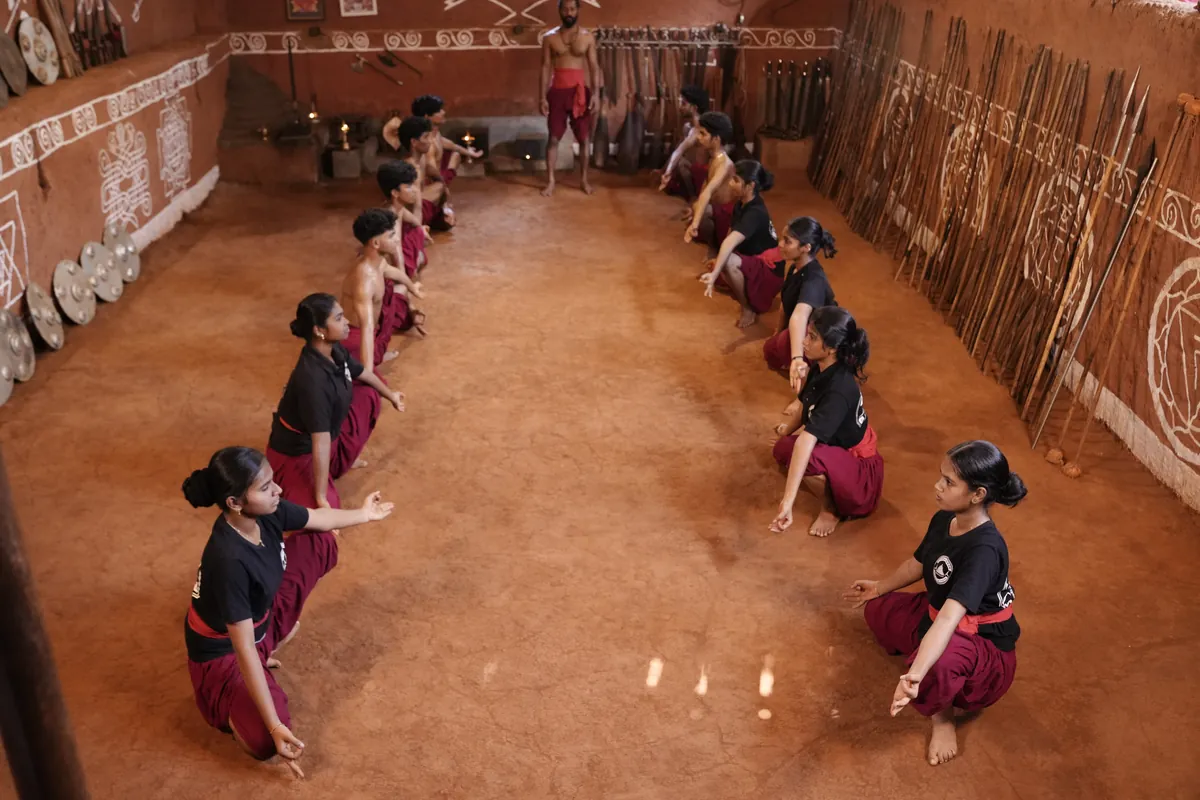
A Kalaripayattu training session at a traditional kalari lasts about 2 hours. It starts with a salutation, then moves through warm-up, kicks, footwork, postures and body sequences. Senior students also train with weapons. The session ends with a short cool down.
At Athma Kalari, sessions run from 5:30 to 7:30 AM and from 5:30 to 7:30 PM. Sundays are off. This guide walks you through a typical session in our kuzhi kalari, step by step, so you know what to expect on your first day.
Where you train: the kuzhi kalari
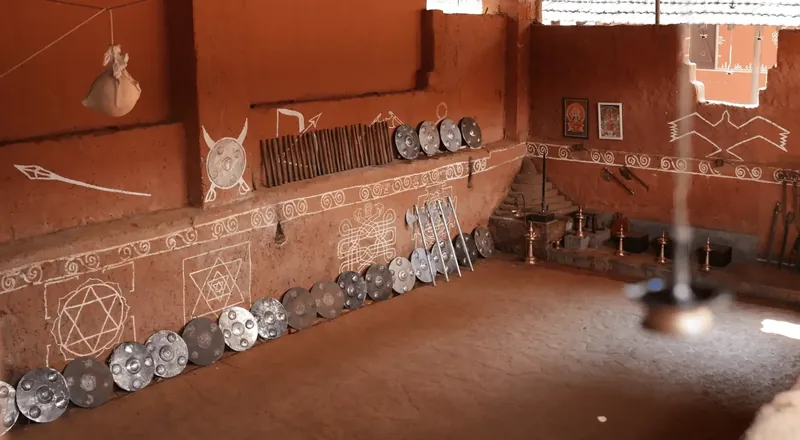
A kuzhi kalari is a traditional training space set below ground level, like a sunken pit. The floor is red earth. It is firm, gives a little under the feet, and is kind to the joints when you jump and land.
You train barefoot. The earth gives you grip, and you start to feel how your weight moves through your feet. Our kalari follows the northern (Vadakkan) style. The teacher is Ashan Vipin Das, the 8th generation of his Kalari family, with 29 years of practice.
Before the session: oil and the kacha
Arrive 5 minutes early. This gives you time to get ready without rushing.
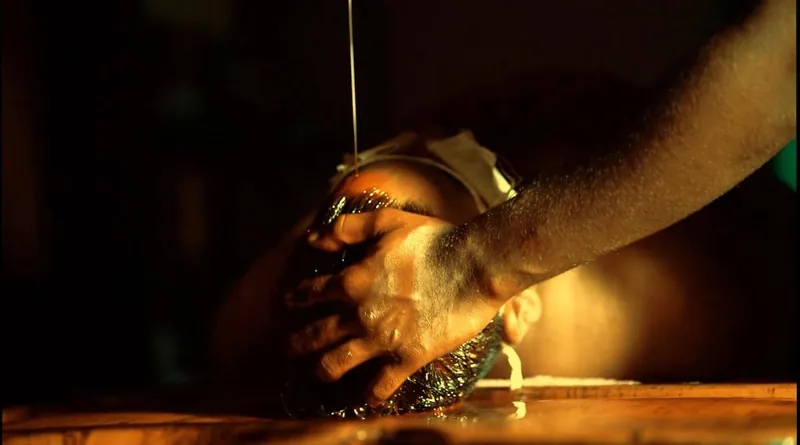
Students apply oil to the body before training. The oil keeps the muscles and joints supple and helps the body warm up. On your first day, ask how much to use.
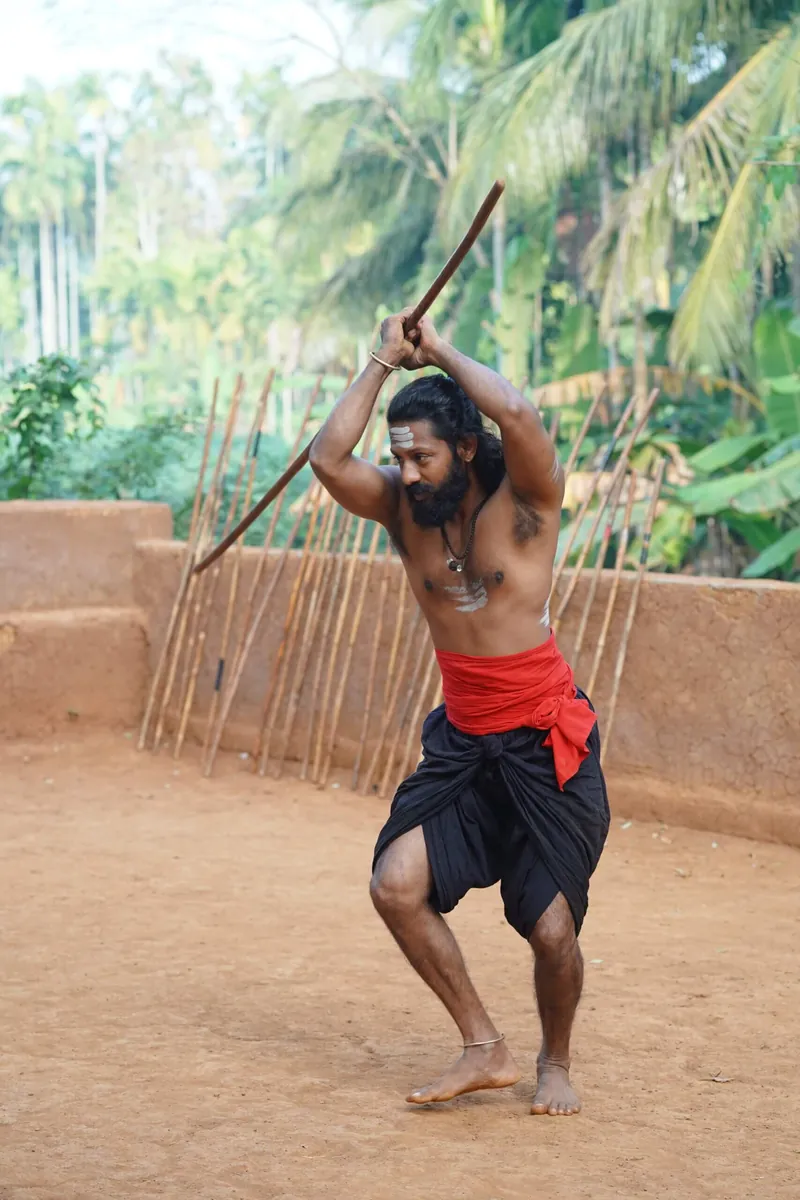
Then you tie the kacha, also called the uduthuketti. It is a long cotton cloth wrapped firmly around the waist and hips and knotted, so the legs can move freely. Men usually train bare-chested. Women and children wear the kacha with a fitted top. Our guide to the Kalari dress shows how it is tied and how to choose a size. In your first classes, loose clothes are fine.
A typical 2-hour session, step by step
1. Vandanam: the salutation
Every session begins with Vandanam, a salutation to the kalari, the teacher and the art. It is a set of movements done slowly and with attention. It settles the mind and marks the start of training. You learn it on day 1. Read more about Kalari Vandanam and its steps.
2. Warm-up and stretching
Next comes the warm-up. You loosen the ankles, knees, hips, spine, shoulders and neck, then stretch the legs and back. The pace starts slow and builds. Hard kicks on cold muscles cause injuries, so this part is never skipped.
3. Kaalukal: kicks and leg swings
Kaalukal are the leg swings and kicks of Kalaripayattu. Students kick in lines, moving across the floor and back, with many repetitions. The kicks go in different directions, and each has its own name. They open the hips and build strength and control in the legs. In the first week, aim for a straight leg and a steady body. Height comes later.
4. Chuvadu and Vadivu: footwork and postures
Chuvadu are the steps: set ways of moving the feet across the floor. Vadivu are the postures. Many are named after animals, such as the elephant, the lion, the horse and the snake. Each posture trains a different way of holding the body low and strong.
The teacher shows a step or a posture, then walks along the line and corrects each student. A small change in the angle of the foot or the height of the hips can change the whole posture.
5. Meypayattu: body sequences
Meypayattu are set sequences that join kicks, steps, postures, turns, jumps and low movements into one flow. Beginners learn the first sequence slowly, one part at a time. Once you know the order, the work is to make it smooth, balanced and fast. Our guide to Meypayattu explains the sequences.
6. Weapons, for senior students
Weapons come after the body is ready. In a regular session, senior students may move on to Kolthari, training with sticks, and later to Angathari, training with metal weapons. Newer students keep working on the body at the same time. This order follows the stages of Kalaripayattu.
7. Cool down
The session ends with a short cool down. You stretch slowly and let the breath settle before you leave the kalari.
What to wear and bring
- The kacha, or loose practice clothes for your first classes.
- Nothing loose or hard on the body. Take off watches and jewellery before you train.
- A small towel and water for after the session.
- Knee or ankle support, if you already use it.
How the first week feels
Expect sore legs and hips in the first days. Kalari uses the body in ways most people do not, with low postures, wide steps and many kicks. Your balance may feel shaky, and the Malayalam commands will be new.
This is normal, and it passes. By the end of the first week, the warm-up and the Vandanam start to feel familiar. You stop thinking about the order and start working on the details.
A few things help:
- Sleep early. The morning session starts at 5:30 AM.
- Rest between sessions, and eat well.
- Tell the teacher at once if something hurts sharply. Soreness is normal. Sharp pain is a signal to stop.
- You can add a short course of Kalari massage during your stay.
Etiquette in the kalari
A kalari is a place of respect. A few simple habits go a long way.
- Take off your footwear before you enter.
- Arrive 5 minutes early.
- Tell the teacher about any injury or health condition before you start.
- Follow the commands. Commands are in Malayalam, and instructions are in basic English. You pick up the commands quickly.
- Watch and listen when the teacher corrects another student. The same correction often applies to you.
- Do not pick up a weapon unless the teacher asks you to.
A typical day for residential students
Residential students train twice a day and live at the gurukulam. Meals come after each session, with time to rest in between.
| Time | What happens |
|---|---|
| 5:30 to 7:30 AM | Morning session in the kalari |
| 9:30 AM | Breakfast |
| Late morning | Rest, wash clothes, read |
| 1:30 PM | Lunch |
| Afternoon | Rest |
| 5:30 to 7:30 PM | Evening session in the kalari |
| 8:30 PM | Dinner |
Sundays are off. Every Tuesday there is meditation. All 3 meals are vegetarian.
Our residential programs are 1 month (Kalari Parijaya, ₹25,500) and 2 months (Kalari Parisrema, ₹51,000). Each price includes training, a stay in the dormitory and 3 meals a day. Other rooms cost more. You start the day you arrive, and no experience is needed. Ashan Vipin Das recommends 2 months if you can.
If you have less time, the 10-Day Program runs on fixed dates, with 3 Kalari sessions a day.
FAQs
Q: How long is a Kalaripayattu session?
A: About 2 hours. At Athma Kalari, sessions run from 5:30 to 7:30 AM and from 5:30 to 7:30 PM, with Sundays off.
Q: What happens in a Kalaripayattu class?
A: A session starts with Vandanam, the salutation. Then come warm-up and stretching, kicks, footwork, postures and body sequences. Senior students also train with weapons. It ends with a cool down.
Q: What do I wear to my first Kalari class?
A: Loose practice clothes are fine at first. Students train barefoot in the kacha, a cotton cloth tied around the waist.
Q: Do beginners use weapons?
A: Weapons come after body training. Sticks come first, and metal weapons much later. On the 10-Day Program, you also learn the long stick.
Q: Will I be sore after the first sessions?
A: Most likely, yes, in the legs and hips. It eases within the first week. Tell the teacher if anything hurts sharply.
Q: Do I need experience to join?
A: No. Beginners start with the basics on day 1. The minimum age is 7.
Come and train
The best way to understand a Kalari session is to stand in the kalari and do one. You can check dates and book your stay, or message us if you have questions first.