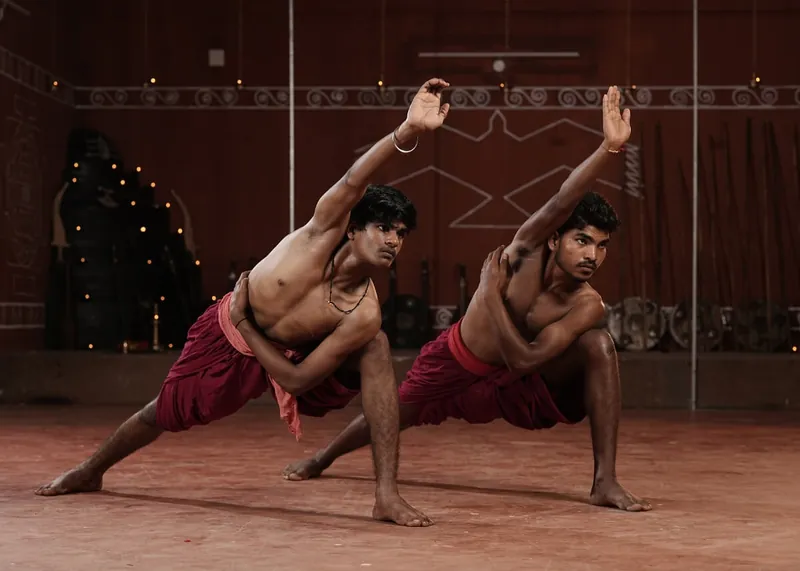
Yes, you can learn Kalaripayattu at home, but only the basics. The warm-up, the Vandanam, simple kicks, footwork and postures can be learned online with a live teacher. Weapons, advanced sequences and partner work cannot, because they need a teacher in the room.
So the honest answer to "can I learn Kalaripayattu at home" is: start at home, then train in person when you want to go further.
This guide explains what you can and cannot learn at home, what our 7-day live workshop covers, how to set up your space, and a safe 15-minute routine you can try today for free.
What you can and cannot learn at home
| Can be learned at home with a live teacher | Needs a teacher in person |
|---|---|
| The Kalari warm-up | Weapons: sticks, sword and shield, and others |
| Kalari Vandanam, the salutation | Long body sequences such as Meypayattu |
| Basic kicks | Jumps, turns and high-speed work |
| Basic footwork | Partner work and empty-hand fighting |
| Postures (Vadivu) | Anything that needs hands-on correction |
Going beyond the basics needs supervision. A teacher must see you from every side, correct your knee or back by hand, and stop you before a mistake becomes an injury. That is why, at Athma Kalari, advanced work is taught only in person.
What 7 live days can teach you
Our online Kalari workshop runs for 7 days, from the 1st to the 7th of every month. Classes are live on Google Meet from 6 to 7 AM IST, in batches of at most 10 students. Teaching is in simple English. The cost is ₹2,600 for the week.
In those 7 days you learn:
- The Kalari warm-up.
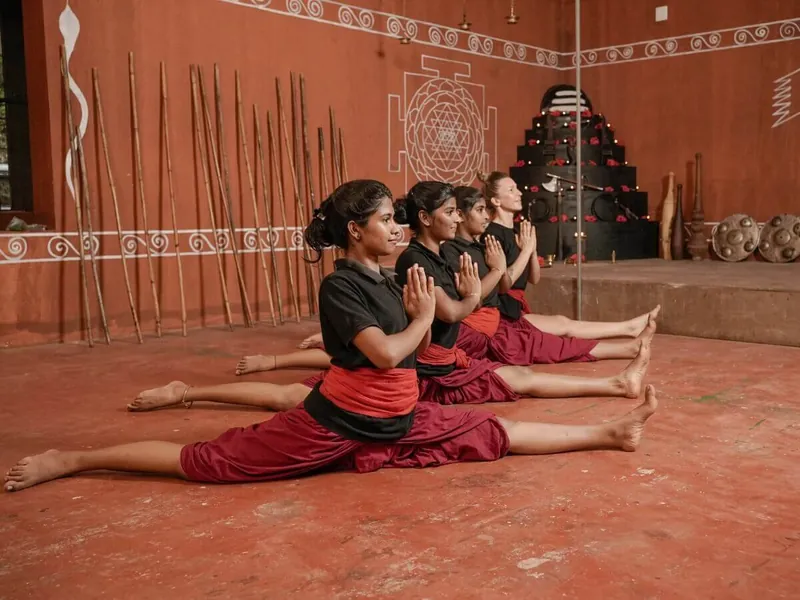
- Kalari Vandanam, the salutation that opens every session.
- 4 basic kicks (Kaalukal).
- Footwork (Chuvadu).
- Postures (Vadivu).
After the workshop, you receive the recordings and written instructions, so you can keep practising on your own. 7 days will not make you a Kalari student. But it gives you a correct base, and a correct base is worth more than months of guessing.
Your space and set-up
- Floor: a clear space of 10 by 5 feet. The floor must not be slippery.
- Internet: a stable connection, so the teacher can see you without breaks.
- Camera: place it so your whole body is in view, from head to feet.
- Food: no full meal for 2½–3 hours before class. Water is fine.
- Equipment: none. Wear loose clothes you can kick in.
Class time in your time zone
Classes are at 6–7 AM India time (IST). In many countries this falls at night or the evening before. Check your local time before you book.
| Where you are | Standard time | Summer time |
|---|---|---|
| UK | 12:30–1:30 AM | 1:30–2:30 AM |
| Central Europe | 1:30–2:30 AM | 2:30–3:30 AM |
| US East Coast | 7:30–8:30 PM, the evening before | 8:30–9:30 PM, the evening before |
| US West Coast | 4:30–5:30 PM, the day before | 5:30–6:30 PM, the day before |
| Dubai | 4:30–5:30 AM | No change |
| Singapore | 8:30–9:30 AM | No change |
| Sydney | 10:30–11:30 AM | 11:30 AM–12:30 PM |
A safe 15-minute beginner routine
If you want to start today, here is a gentle routine you can do at home for free. It does not replace a teacher. It simply wakes the body up and prepares the legs for Kalari kicks.
| Minutes | What to do |
|---|---|
| 0–5 | Gentle warm-up |
| 5–8 | Vandanam, as you were taught |
| 8–13 | Simple leg swings |
| 13–15 | Cool down and breathe |
1. Gentle warm-up (5 minutes)
- March on the spot for 1 minute, lifting the knees a little.
- Roll the shoulders back 10 times, then forward 10 times.
- Make slow circles with the arms, small and then larger.
- Put your hands on your hips and circle the hips slowly, 5 times each way.
- Bend the knees a little and straighten them, 10 times, with the back tall.
- Lift 1 foot and circle the ankle, 5 times each way, then change feet.
2. Vandanam (3 minutes)
Kalari Vandanam is the salutation to the kalari, the teacher and the tradition. If a teacher has taught it to you, practise it slowly, exactly as taught. If you have not learned it yet, do not try to copy it from a video. Instead, stand still with your feet together and your palms together at the chest. Take 10 slow breaths through the nose, and set your mind on careful practice.
3. Simple leg swings (5 minutes)
- Stand side-on to a wall and rest 1 hand on it for balance.
- Swing the outer leg forward and back, 10 times. Start low and let the swing grow a little each time. Keep your back tall and the standing knee soft.
- Turn around and repeat with the other leg.
- Now face the wall, both hands on it. Swing 1 leg across the body and out to the side, 10 times. Then change legs.
These swings prepare the hips for Kalari kicks, but they are not the kicks themselves. Proper Kaalukal need correction from a teacher.
4. Cool down (2 minutes)
Walk slowly around the room. Shake out the legs. Then stand still and breathe slowly until your heart rate settles.
Safety notes
- Train barefoot on a floor that is not slippery, with nothing around you that you could hit.
- Never kick high with cold muscles. Height comes with weeks of practice.
- Do not use sticks or any weapon at home.
- See a doctor before you start if you have a recent fracture, severe or sudden pain, numbness, a fever, are pregnant, or have had recent surgery.
Stop at once if you feel
- Sharp or stabbing pain, in a joint or anywhere else.
- Dizziness, chest pain or trouble breathing.
- Numbness or tingling in the arms or legs.
- Pain in the knee, hip or lower back that gets worse as you move.
Why live correction beats free videos
There are many free Kalari videos online. They can inspire you, but they cannot see you. A video will not tell you that your knee is turning in, that your back is rounding, or that you are holding your breath.
In a live class, the teacher watches you and corrects you as you move. Small fixes in the first week save you from bad habits and injuries later. With a batch of at most 10, the teacher has time to see each student.
From online to a residential stay
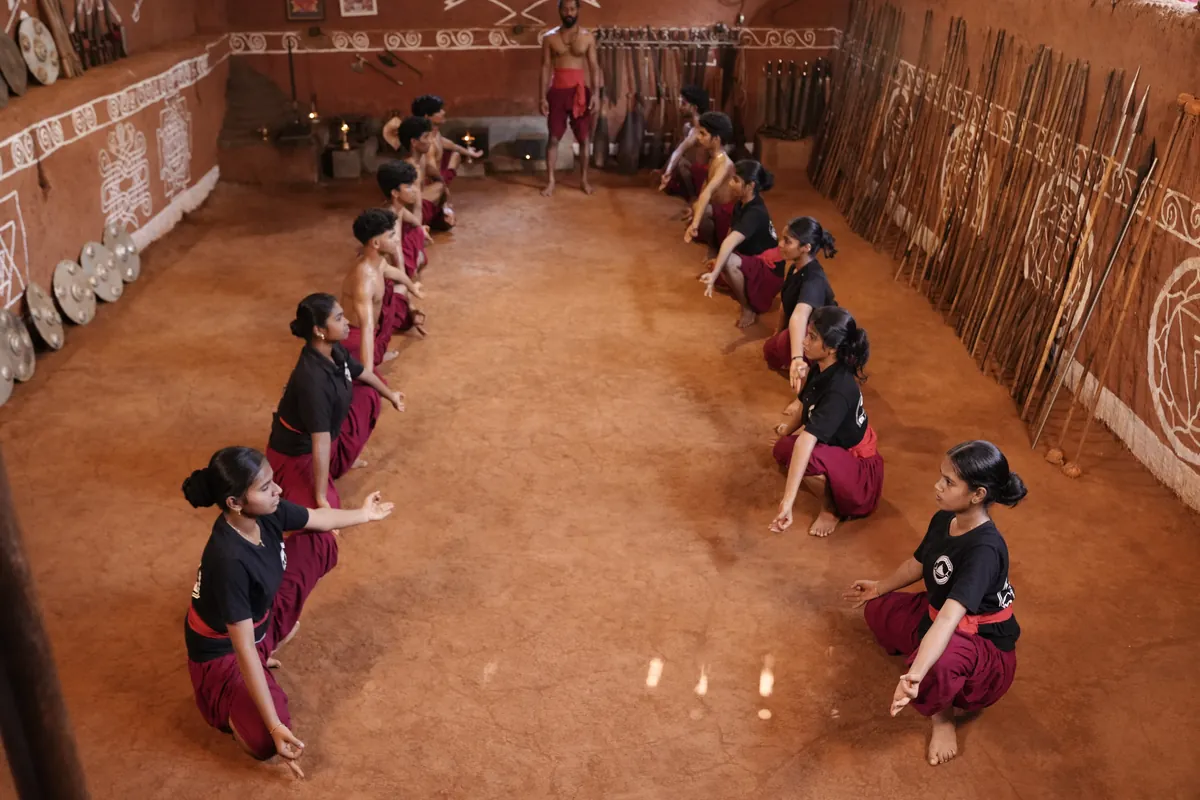
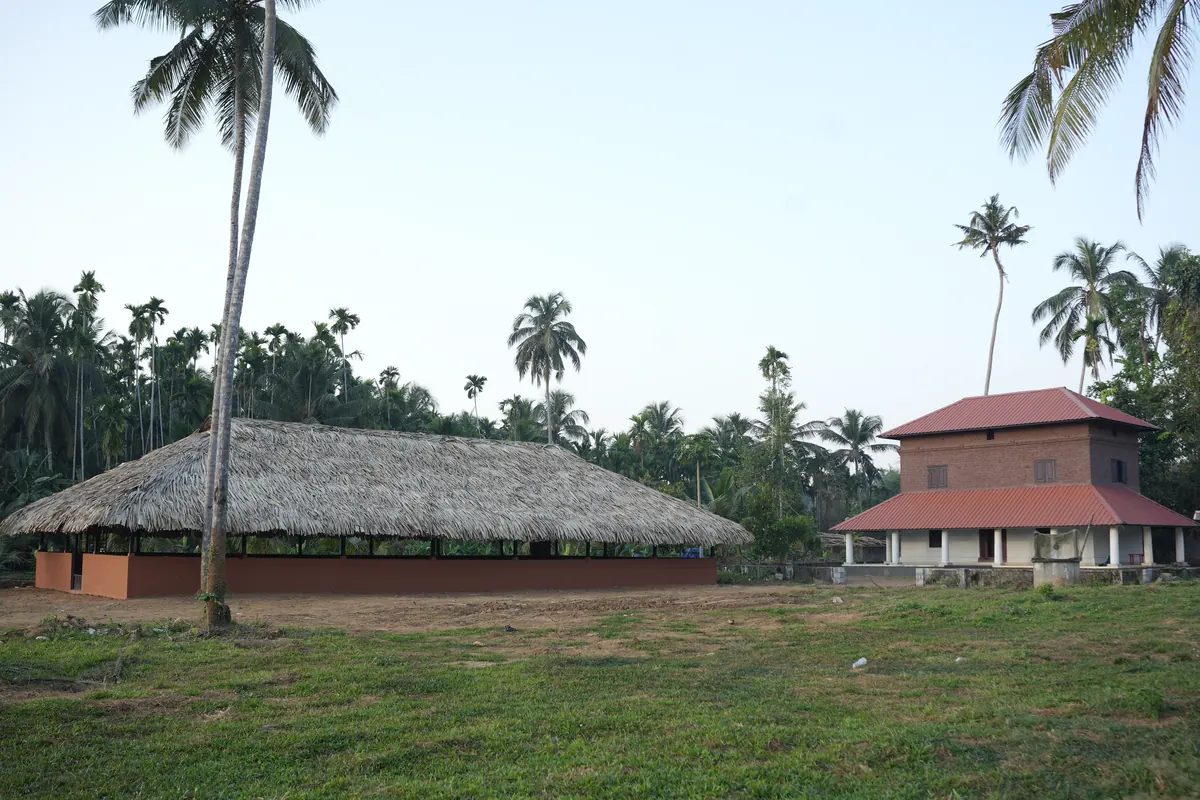
A good path is to start online, then come to Kerala to train in person. At the gurukulam you train twice a day in a traditional kalari, eat 3 vegetarian meals a day, and build on the basics you already know. Our residential programs run from 2 weeks to 2 months, and you start the day you arrive.
FAQs
Q: Can I learn Kalaripayattu at home?
A: Yes, the basics: warm-up, Vandanam, simple kicks, footwork and postures. Weapons and advanced work need a teacher in person.
Q: Can I learn Kalaripayattu online for free?
A: The 15-minute routine above is free. Our live 7-day workshop costs ₹2,600 and includes recordings and written instructions.
Q: What time are the online classes?
A: 6–7 AM IST, from the 1st to the 7th of every month, on Google Meet.
Q: Do I need any equipment?
A: No. You need a clear, non-slip floor of 10 by 5 feet and a stable internet connection.
Q: Is the online workshop good for complete beginners?
A: Yes. It is built for beginners, and teaching is in simple English.
Join the next online workshop
If you want to learn the basics correctly from home, the next workshop starts on the 1st of the month. The dates, times and registration are on the workshop page linked above. If you have questions about your space or time zone, message us before you book.