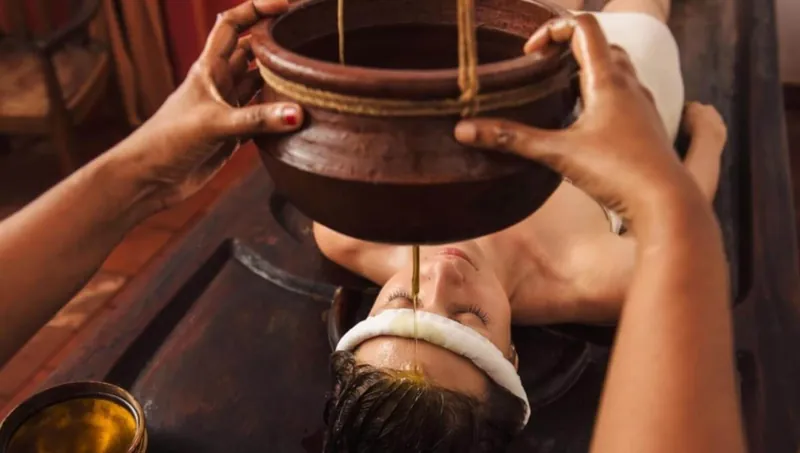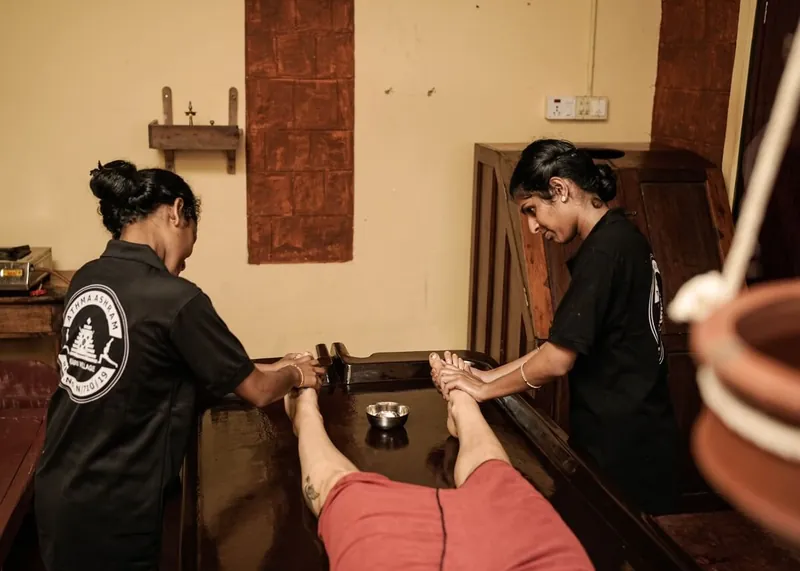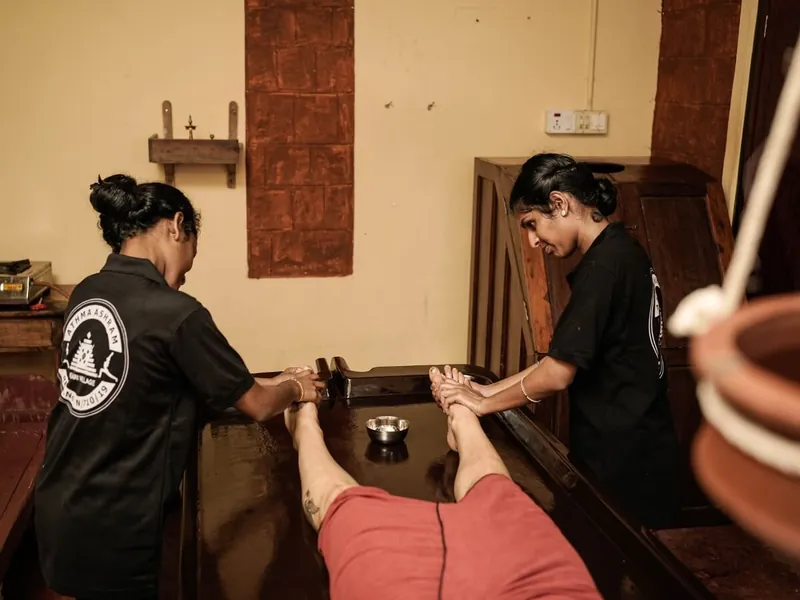
Chavitti Uzhichil is a Kalari foot massage. The therapist holds an overhead rope for balance and massages your body with the feet, using warm medicated oil. The strokes are long, deep and even.
Chavitti comes from the Malayalam word for stepping or treading, and Uzhichil is the Kalari name for massage. You may also see it called Chavutti Thirumal, Kalari foot massage or foot pressure massage. In Kerala it has long been linked with Kalaripayattu and with Kathakali, the classical dance-drama.
At Athma Kalari, it is one of the 12 Kalari therapies. It is prescribed after a consultation. It is not chosen from a menu.
How Chavitti Uzhichil works
A rope hangs above the treatment area. The therapist stands over you and holds the rope with both hands. The rope carries part of the therapist's weight, so the pressure through the foot stays steady and under control.
Warm oil is applied first. Then the therapist uses the sole of the foot in long, sweeping strokes that run the length of the body, along the muscles and over the marma points. A foot covers a wider area than a hand, and body weight gives deep, even pressure. You lie face down for part of the session and turn over for the rest.
The aim is to reach deep, long-held stiffness in large muscles, such as the back, hips and legs, and to help the body open up.
A tradition of fighters and dancers
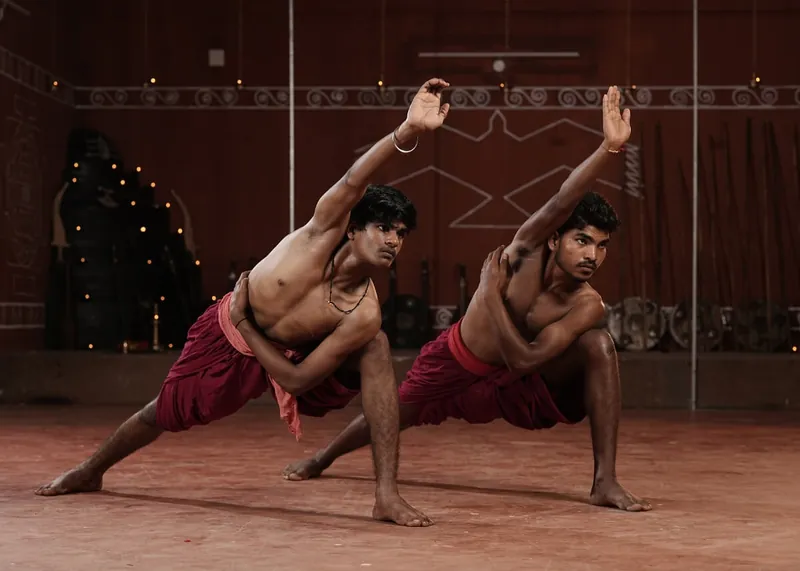
Kalaripayattu and Kathakali both ask a great deal of the body. Both need deep stances, high kicks, wide stretches and long hours of practice. Tradition holds that foot massage has been used in both to keep the body supple.
It is widely said that Kathakali students have received this kind of massage during their training for generations. In the kalari, students are given Uzhichil so they can stretch further and recover from hard training. Chavitti Uzhichil is the deepest form of it.
What it feels like
The pressure is deep and the strokes are slow. It feels strong, heavy and warm. It should not be sharp or painful. If the pressure is too much, say so, and the therapist will change it.
Afterwards you may feel loose and sleepy. You may also feel a little sore the next day, much like after a hard training day. Rest after the session, keep warm, and take a warm bath later.
Who it suits
- Kalari students and others in hard physical training
- dancers, athletes and people who are already fairly flexible
- people with deep muscle stiffness who have had hand Uzhichil before
It is not usually the first treatment for someone new to Kalari massage. Hand Uzhichil is usually prescribed first. Chavitti Uzhichil may follow if your body is ready for it. You can read about hand Uzhichil in our guide to Kalari massage in Kerala.
Who should avoid it
This is a deep treatment, so it is not right for every body. See a doctor first if you have:
- a recent fracture
- severe or sudden pain
- numbness in an arm, leg, hand or foot
- fever
- pregnancy
- recent surgery
Chavitti Uzhichil is also usually not suitable if you have weak or fragile bones, a back or disc problem that is flaring up right now, varicose veins, or a history of blood clots. It is not done over open wounds, rashes or infected skin, or over a fresh injury that is hot and swollen.
Tell Ashan Vipin Das about any heart condition, high blood pressure, diabetes or medicine you take. If he feels hand Uzhichil is safer for you, he will tell you why.
Chavitti Uzhichil can help ease deep stiffness. It is not a replacement for medical care.
How to ask for Chavitti Uzhichil
You cannot book Chavitti Uzhichil on its own. Ashan Vipin Das first examines you. He has 29 years of Kalari practice and is the 8th generation of his Kalari family. He asks about your history, checks the problem area and reads your pulse. Then he decides whether Chavitti Uzhichil suits you, and for how many days. Nothing is prescribed before this.
If you would like it, say so when you message us and again at the consultation. The cost depends on your plan, so ask us for a price.
You do not need to be a Kalari student to be treated. Female therapists treat women.
Learning Chavitti Uzhichil at Athma Kalari
A therapist giving this massage needs strong balance, steady control and a good knowledge of the marma points. For this reason it is taught late in the training at Athma Kalari.
The path starts with Kalari Parijaya, the 1-month residential program. Next comes the 4-month Kalari TTC, which covers teaching technique. After that, students may be invited to the Advanced TTC, 5 months at ₹2,50,000 (₹50,000 a month). It adds practical sessions on basic and common treatments: Kalari leg massage, Kizhi, medicinal bandaging and, for advanced students, Chavitti Uzhichil. To be certified you complete the full months.
You can read more about each course on our Kalari teacher training page.
FAQs
Q: Is Chavitti Uzhichil the same as Chavutti Thirumal?
A: Both names are used for a foot massage given while holding an overhead rope. Styles and names vary from place to place.
Q: Does Chavitti Uzhichil hurt?
A: It is deep, but it should not be painful. Tell the therapist if the pressure is too much.
Q: Can I have it as my first Kalari massage?
A: Usually not. Hand Uzhichil is usually prescribed first. Ashan Vipin Das decides after a consultation.
Q: Why does the therapist hold a rope?
A: The rope gives balance and lets the therapist control how much body weight goes into each stroke.
Q: Can I learn Chavitti Uzhichil at Athma Kalari?
A: It is taught to advanced students in the Advanced TTC. You reach it after Kalari Parijaya and the Kalari TTC.
Asking about Chavitti Uzhichil
If you think this massage could suit you, message us with your age, any injuries and what you hope to ease. We will tell you whether a consultation makes sense for you. To understand the points the therapist works on, read about the marma points in Kalari.